|
HISTORY OF SAN ANTONIO TEXAS


SAN ANTONIO TEXAS
San Antonio, located at the headwaters of the San Antonio River in Bexar County,was explored by Spanish expeditions in 1691 and 1709.
The present day town of San Antonio grew out of the settlement of San Antonio de B�xar Presidio (founded 1718), and the villa of San Fernando de B�xar, chartered by Canary Islanders in 1731.
Beginning in 1718, five Spanish missions were located along the river. The presidial captain's house (later the Spanish Governor's Palace) was completed on Military Plaza in 1749, and the San Fernando de B�xar Church was built by 1758.
In 1773 San Antonio de B�xar became the capital of Spanish Texas. In 1778 the settlement had a population of 2,060, including mission Indians.
The missions were all secularized by 1795, and San Antonio de Valero Mission (later, the Alamo) became a military barracks. San Antonio declared for Mexican independence in 1813; it was recaptured by Royalist forces after the battles of Alaz�n Creek and Medina, and the population was decimated by purges.
During the Texas Revolution, San Antonio was the site of several battles, including the siege of Bexar (December 1835) and the battle of the Alamo (March 6, 1836), which made it one of the most fought-over cities in North America.
After the evacuation of Mexican forces, Bexar County was organized by the Republic of Texas in December 1836, and San Antonio was chartered in January 1837 as its seat. A failed attempt to negotiate the release of captives held by Comanche Indians resulted in yet another battle in the streets of the town, the Council House Fight of 1840.
San Antonio was seized twice in the Mexican invasions of 1842, and the population was reduced to about 800 in 1846.
After Texas entered the Union, growth became rapid, as the city became a servicing and distribution center for the western movement of the United States. The census showed 3,488 in 1850 and 8,235 in 1860, when San Antonio had become for the time the largest town in Texas (ahead of Galveston). Germans made up a large part of this growth; German speakers outnumbered both Hispanics and Anglos until after 1877. In 1861 local militia forced the surrender of the federal arsenal at San Antonio even before the state seceded on March 2. Subsequently, San Antonio served as a Confederate depot. Several units such as John S. Ford's Cavalry of the West were formed there, though the city was removed from the fighting.
After the Civil War, San Antonio prospered as a cattle, distribution, mercantile, and military center serving the border region and the Southwest. The city was the southern hub and supplier of the cattle trail drives. An important wool market developed with the importation of merino sheep to the adjacent Hill Country. With the coming of the Galveston, Harrisburg and San Antonio Railway in 1877, San Antonio, formerly without a transportation system, entered a new era of economic growth.
The population reached 20,550 in 1880. The new immigration was overwhelmingly native-born Anglos, mostly from Southern states. In 1881 a second railroad, the International�Great Northern, reached the city from the northeast, and five railroads had built into the city by 1900. Modernization was explosive in the 1880s, comparable to growth patterns across the United States. Civic government, utilities, street paving and maintenance, water supply, telephones, hospitals, and a power plant were all established or planned.
San Antonio was once again the largest city in the state in 1900, with a population of 53,321; it remained the largest city in 1910, with 96,614 inhabitants, and 1920, with 161,379. After 1910 Mexican immigration greatly increased due to the Mexican Revolution and the development of local service industries. The confluence of Hispanic, German, and Southern Anglo-American cultures in San Antonio made it into one of America's "four unique cities" (along with Boston, New Orleans, and San Francisco). Each successive group of immigrants put its stamp upon the city, its culture, and architecture; all mingled, none quite submerging the others. Each period of growth produced characteristic and often distinguished architecture. Peculiarly, San Antonio succeeded in merging its past into the new in each generation. Old Spanish walls remain beside modern glass towers, with rows of Victorian mansions a block away, a combination that lends the city a charm sought out by millions of visitors.
Tourism is one of the city's most important industries, for San Antonio's many attractions, including sports, draw tens of thousands of visitors every year. Among the most recent features is Fiesta Texas, Sea World in San Antonio is the largest marine-life theme park in the world. The famed Riverwalk, Paseo del Rio, consists of over 1� miles of cool, shady, walks with shops, cafes, restaurants, and clubs.
HemisFair '68 left a number of permanent buildings, including the Tower of the Americas, which has an observation deck and restaurant on top.
The San Antonio Botanical Gardens and Conservatory is a thirty-three-acre horticultural facility featuring the flora of Texas, ranging from the wildflowers of the Hill Country to the formal rose gardens of East Texas. The indoor collection houses exotic plants from all over the world.
Some of the other attractions in San Antonio include:
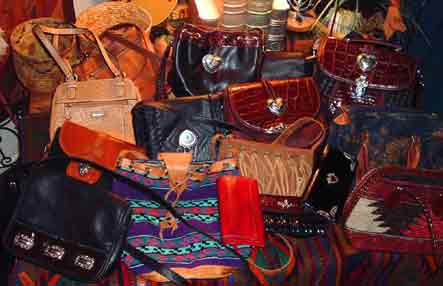
El Mercado, the old marketplace with a touch of Mexico
the Sunken Gardens, lush Japanese gardens preserved in a natural setting
the San Antonio Zoo, at Brackenridge Park
the Menger Hotel
the Hertzberg Circus Collection and Museum, an extensive collection of circus memorabilia
and the University of Texas Institute of Texan Cultures, a museum documenting the ethnic groups that built Texas.
San Antonio's major annual events include Fiesta San Antonio in April, the San Antonio Annual Livestock Show and Rodeo in February, the Texas Folklife Festival in June, and the Riverwalk Christmas Lighting in December. The Alamo (1718), Mission Concepci�n (1731), Mission San Jos� (1720), Mission San Juan Capistrano (1731), and Mission San Francisco de la Espada (1741) compose San Antonio Missions National Historical Park, one of a few urban national parks in the country. Architecturally interesting sights abound: San Fernando Cathedral (1758), the Spanish Governor's Palace (1749), the Quadrangle at Fort Sam Houston (1878), and the Bexar County Courthouse (1891) are but a few. San Antonio, with its unique architectural heritage dating from the Spanish era, was one of the first cities apart from the Eastern seaboard to become preservation conscious. The San Antonio Conservation Society, founded in 1924, was instrumental in saving the beautiful San Antonio River, which winds through downtown, from being paved over for a drain. The society has since become a popular and powerful organization devoted to preserving the city's unique features. Recognizing the value and impact of the city's cultural sites upon the economy and stability of the community, the city maintains a Historic Preservation office as part of planning, and has passed a model comprehensive historic-preservation code that provides tax incentives to encourage preservation and rehabilitation. The King William and Monte Vista historic districts are outstanding examples of neighborhood restoration efforts. In sports, the Alamodome hosts major college football and basketball events, and the SBC Center is the home venue for the San Antonio Spurs of the National Basketball Association and the city's newest franchise, the Silver Stars of the Women's Basketball Association (WNBA). The Texas Open golf tournament is held each year at Oak Hills Country Club, and the R. J. Reynolds PGA Seniors Tournament is an annual event at the Dominion. Other professional sports teams include the San Antonio Missions baseball team, the San Antonio Racquets, and the San Antonio Iguanas (a National Hockey League team). .
This is a work in progress. Bookmark this page and come back often. If you have old photographs or family history relating to the San Antonio area, please email me a copy and I'll include your photos on this webpage.
Thanks
Leonard Kubiak
leonard@forttumbleweed.net
 For questions or comments, send me an Emailat leonard@forttumbleweed.net or lenkubiak.geo@yahoo.com For questions or comments, send me an Emailat leonard@forttumbleweed.net or lenkubiak.geo@yahoo.com
|